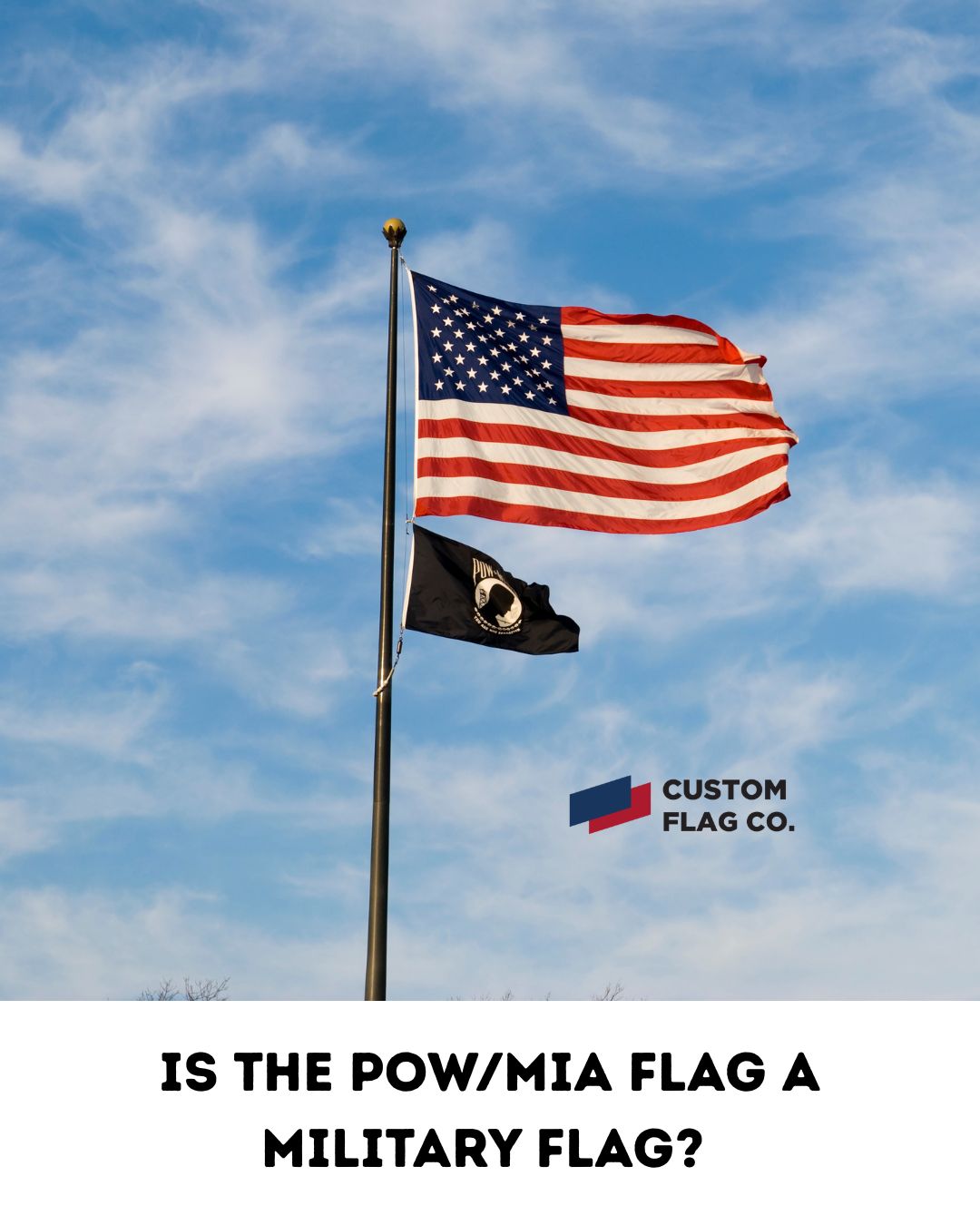
When you see the stark black and white silhouette of a bowed head behind barbed wire, the message is immediate and powerful: “You Are Not Forgotten.” We often get asked the question: Is the POW/MIA flag technically a military flag?
The answer is both a “yes” and a “no,”. Depending on whether you are looking at it through a legal lens or a cultural one.
The Legal Distinction
Strictly speaking, the POW/MIA flag does not land in the same category as a service flag like the flags for the Army, Navy, Air Force, Marine Corps, Coast Guard, or Space Force. Those flags represent specific branches of the Department of Defense.
However, the POW/MIA flag holds a unique official status that no other civilian flag possesses. In 1990, Congress passed Public Law 101-355, officially recognizing it as “the symbol of our Nation’s concern and commitment to resolving as fully as possible the fates of Americans still prisoner, missing, and unaccounted for in Southeast Asia.”
Why It’s Often Classified as Military
While not representing a branch, it is deeply embedded in military protocol. Under the National POW/MIA Flag Act, it is required to be flown at specific federal locations, including the White House, the U.S. Capitol, and every major military installation, on several days throughout the year, such as Veterans Day and Armed Forces Day.
Displaying It With Respect
Because of its official status and the gravity of what it represents, it is treated with the same reverence as military flags. If you are flying it on a single flagpole with the U.S. flag, the POW/MIA flag should fly directly beneath the American flag. It typically takes precedence over state or corporate logo flags.
Whether you consider it a military flag or a national symbol of remembrance, its purpose is clear: to ensure the sacrifice of those who never returned remains in the public eye.



Leave a Reply
You must be logged in to post a comment.